
The Entourage Effect: Why Whole-Plant Cannabis Matters
If you've ever wondered why a high-THC flower feels different from the same amount of THC in a distillate vape, the entourage effect is the reason people point to most often. It's the idea that cannabis compounds work better together than alone — that the plant's natural combination of cannabinoids, terpenes, and other molecules produces a richer, more nuanced experience than any single compound can on its own. It's one of the most influential theories in modern cannabis science, and also one of the most debated.
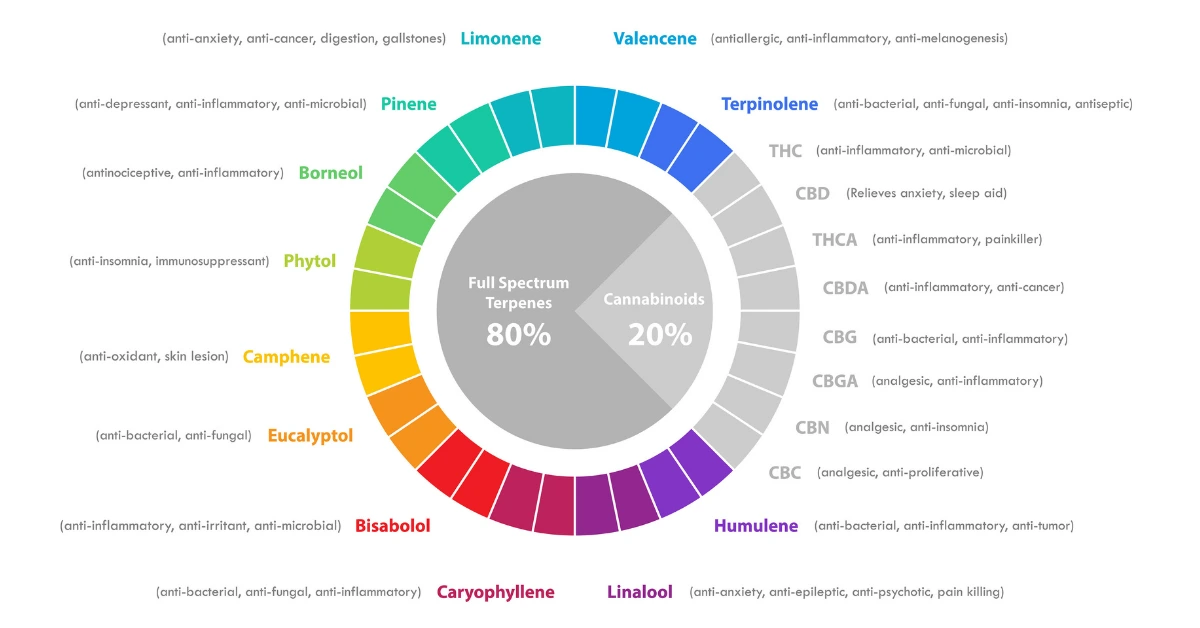
Diagram of cannabinoids and terpenes illustrating the entourage effect in cannabis.
What Is the Entourage Effect?
The entourage effect is the theory that the hundreds of compounds in cannabis — THC, CBD, minor cannabinoids, terpenes, and flavonoids — interact synergistically to produce effects that are greater than the sum of their parts. The term was coined in 1998 by Raphael Mechoulam, the Israeli chemist who first isolated THC, and popularized in 2011 by neurologist Dr. Ethan Russo in his landmark paper Taming THC (Russo, 2011, British Journal of Pharmacology).
In simple terms: isolated THC and full-spectrum cannabis flower with the same THC content can feel noticeably different, and the entourage effect is the proposed explanation.
How It's Supposed to Work
The theory proposes several mechanisms that could explain synergy:
Terpenes modulating THC — some terpenes may reduce THC-induced anxiety, enhance relaxation, or support focus.
Cannabinoids balancing each other — CBD, for example, may temper some of THC's intoxicating effects.
Multiple receptors activated at once — full-spectrum products engage a broader range of receptors than single-molecule products.
Enzyme modulation — some compounds affect how the body metabolizes others, changing onset and duration.
The Science Supporting It
Research on the entourage effect is growing but still developing. A 2018 study in Frontiers in Neurology analyzed cannabis use in epilepsy patients and found that CBD-rich extracts containing additional cannabinoids and terpenes were more effective than purified CBD alone, with patients requiring four times lower doses of the extract (Pamplona et al., 2018).
A 2021 study in Scientific Reports found that several cannabis terpenes produced cannabinoid-like effects in mice and appeared to enhance cannabinoid activity at CB1 receptors, offering direct evidence that terpenes are pharmacologically active rather than just aromatic (LaVigne et al., 2021).
The Honest Counterpoint
Not every researcher is convinced. A 2019 review in Cannabis and Cannabinoid Research pointed out that while the entourage effect is plausible, much of the supporting evidence is preclinical or anecdotal, and rigorous human clinical trials are limited (Cogan, 2020). Some scientists argue that the effect is real but often exaggerated by marketers selling "full-spectrum" products at a premium.
The honest position is somewhere in the middle: there's meaningful evidence that whole-plant cannabis and isolates don't feel identical, but the science isn't yet precise enough to predict exactly which combinations produce which effects.
Entourage Effect and Terpenes
Terpenes are the most visible part of the entourage effect conversation because they're the easiest to measure and the easiest to smell. Russo's 2011 paper proposed specific cannabinoid–terpene combinations for specific conditions: CBD plus limonene for depression, CBD plus linalool for anxiety, THC plus myrcene for sleep, and so on. The specifics are still being tested, but the broader principle — that terpenes matter — has become mainstream. For more, see our full cannabis terpenes guide.
What "Full-Spectrum" Means on a Label
If the entourage effect is real, then how cannabis is processed matters. Here's the shorthand:
Isolate — a single compound (usually CBD or THC) purified to 99%+. No entourage effect possible.
Broad-spectrum — multiple cannabinoids and terpenes, but with THC removed.
Full-spectrum — the complete chemical profile of the plant, including THC, minor cannabinoids, and terpenes.
Live resin / live rosin — full-spectrum extracts processed to preserve the maximum number of terpenes and minor cannabinoids.
For more on extraction methods, see our guide to cannabis concentrates.
How to Shop with the Entourage Effect in Mind
Prioritize terpene-tested products. If you can't see the terpene profile, you're shopping in the dark.
Try live resin or live rosin. These preserve more of the original chemical profile than distillates.
Don't chase THC percentage alone. A 20% flower with a rich terpene profile can feel stronger and more pleasant than a 30% distillate.
Experiment with minor cannabinoids. Products with measurable CBG, CBN, or THCV often feel distinct from THC-only products.
Frequently Asked Questions
Is the entourage effect proven?
It's supported by a growing body of research but not yet considered settled science. There's strong evidence that terpenes and cannabinoids influence each other, but the specifics — which combinations produce which effects in humans — still need more clinical trials.
Do edibles have an entourage effect?
It depends on how they're made. Distillate-based edibles have less of an entourage effect because many terpenes are lost during processing. Live-resin or full-spectrum edibles preserve more of the profile and are closer to whole-plant cannabis.
Is CBD more effective with THC?
Some research suggests yes, especially for pain and inflammation. CBD also appears to soften some of THC's more intense effects, which is why balanced 1:1 products are popular among people sensitive to THC.
Does vaping preserve the entourage effect better than smoking?
Vaping at lower temperatures preserves more terpenes than combustion, which can enhance the entourage effect. See vaping vs. smoking cannabis for more.
Is distillate "worse" than live resin?
Not worse — just different. Distillate is cleaner and more potent in terms of isolated cannabinoids. Live resin is more flavorful and often described as more well-rounded. Both have their place.
The Bottom Line
The entourage effect is the best current explanation for why whole-plant cannabis feels different from isolated compounds. The science is still developing, but the principle — that terpenes and minor cannabinoids matter — has already changed how people shop. The takeaway for consumers is simple: a strain's full chemical profile matters more than any single number on the label.
Browse full-spectrum flower and live resin at Bloom Ohio or Bloom Maryland.