
The Endocannabinoid System: How Cannabis Works in Your Body
Your body has a built-in system designed to interact with cannabis. It existed for millions of years before anyone rolled a joint. It's called the endocannabinoid system, or ECS, and it's one of the most important regulatory networks in human biology — responsible for balancing everything from mood and memory to pain, appetite, and sleep. Understanding the ECS is the single best way to understand why cannabis affects you the way it does.
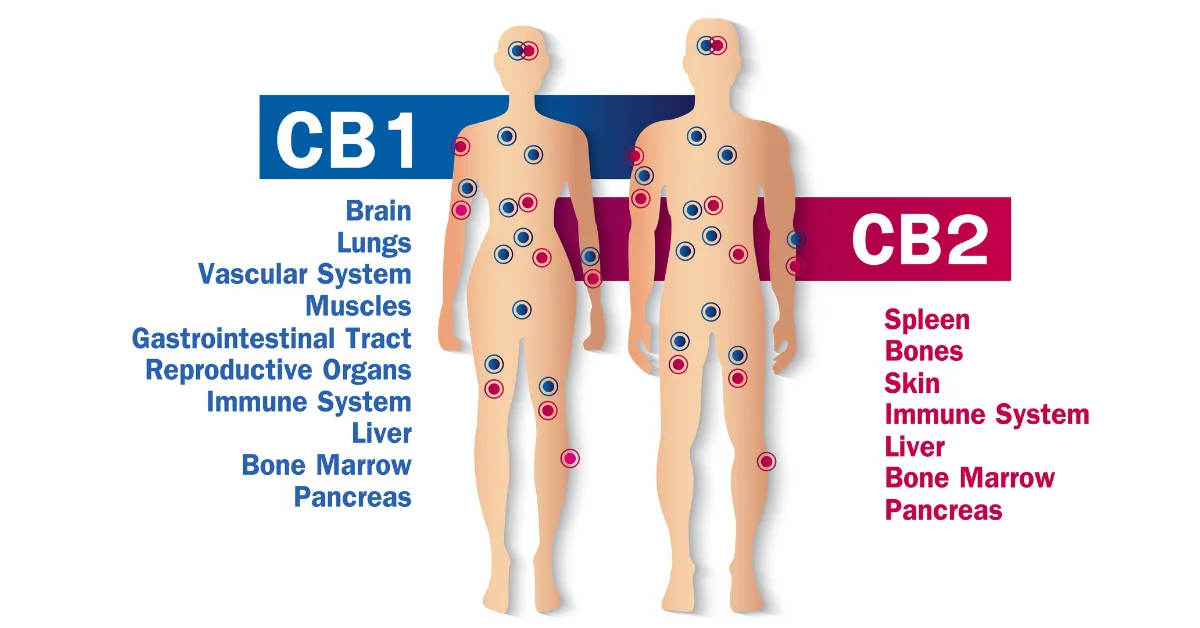
Diagram of the endocannabinoid system showing CB1 and CB2 receptor locations throughout the body.
What Is the Endocannabinoid System?
The endocannabinoid system is a network of receptors, signaling molecules, and enzymes that helps your body maintain homeostasis — the internal balance that keeps everything running smoothly. First identified in the early 1990s by researchers studying how THC affects the brain, the ECS is now recognized as one of the largest neurotransmitter systems in the human body.
The ECS was discovered almost by accident. Scientists were trying to figure out how THC produced its effects, and in the process they uncovered an entire signaling system the body uses on its own, without cannabis involved (Lu & Mackie, 2016, Biological Psychiatry). Every vertebrate animal studied so far has one.
The Three Parts of the ECS
1. Cannabinoid Receptors
Receptors are docking stations on the surface of cells. The ECS has two main types: CB1 and CB2.
CB1 receptors are concentrated in the brain and central nervous system. They're responsible for the psychoactive effects of THC — the euphoria, the altered perception, the appetite stimulation.
CB2 receptors are found mostly in the immune system and peripheral tissues. They're involved in inflammation, pain signaling, and immune response, and they don't produce a "high" when activated.
2. Endocannabinoids
Your body makes its own cannabinoids, called endocannabinoids. The two best-studied are anandamide (named after the Sanskrit word for "bliss") and 2-AG. These molecules are produced on demand when your body needs to restore balance — after injury, stress, or exertion — and they bind to CB1 and CB2 receptors to trigger a response.
The "runner's high" people feel after long exercise, for example, is now believed to be driven largely by anandamide, not just endorphins.
3. Enzymes
Once endocannabinoids have done their job, enzymes break them down so they don't keep signaling indefinitely. FAAH breaks down anandamide; MAGL breaks down 2-AG. This rapid breakdown is part of why endocannabinoid effects are subtle and short-lived — and why plant cannabinoids like THC, which resist those enzymes, can produce effects that last hours.
How Cannabis Interacts with the ECS
Plant cannabinoids — called phytocannabinoids — are shaped similarly enough to your body's own endocannabinoids that they can bind to the same receptors. THC binds strongly to CB1 receptors in the brain, which produces the classic cannabis high. CBD, by contrast, doesn't bind strongly to CB1 or CB2 directly; it appears to work by influencing the enzymes that regulate endocannabinoid levels and by interacting with other receptors entirely (Pertwee, 2008, British Journal of Pharmacology).
For more on the differences between these two major cannabinoids, see our guide to THC vs. CBD. For the lesser-known cannabinoids that also interact with the ECS, see major vs. minor cannabinoids.
What the ECS Regulates
The ECS touches nearly every major system in the body. Research has linked it to the regulation of:
Mood and stress response
Pain perception
Appetite and digestion
Sleep cycles
Memory and learning
Immune function and inflammation
Motor control
Reproductive health
Because the ECS is involved in so many processes, cannabis can produce a wide range of effects depending on the strain, the dose, and the individual — which is why one person feels relaxed while another feels anxious from the same product.
Endocannabinoid Deficiency: A Working Theory
Dr. Ethan Russo has proposed a theory called Clinical Endocannabinoid Deficiency (CED), which suggests that some chronic conditions — particularly migraine, fibromyalgia, and irritable bowel syndrome — may involve an underactive endocannabinoid system (Russo, 2016, Cannabis and Cannabinoid Research). It's still a hypothesis, but it's one of the most interesting frontiers in cannabis medicine and helps explain why some patients respond strongly to cannabinoid therapy.
Why the ECS Matters for Cannabis Consumers
Understanding that the ECS exists — and that it's your body, not the plant, doing most of the work — changes how you think about cannabis. The plant isn't forcing effects onto you. It's activating a system that was already there, and your individual endocannabinoid biology is the reason your experience might be completely different from a friend's.
This is also why building tolerance, taking breaks, and starting with low doses all matter so much. For practical guidance, see our guides to microdosing cannabis and the entourage effect.
Frequently Asked Questions About the Endocannabinoid System
Do all animals have an endocannabinoid system?
All vertebrates and many invertebrates have an ECS, which means your dog and cat also respond to cannabinoids (though THC is toxic to pets in typical human doses — never share). The ECS has been identified in sea squirts, which diverged from humans over 600 million years ago.
Can I boost my endocannabinoid system without cannabis?
Yes. Exercise, particularly aerobic activity, raises anandamide levels. Certain foods — dark chocolate, omega-3-rich fish, and some herbs — also contain compounds that interact with the ECS. Sleep, stress management, and healthy fats all support endocannabinoid function.
Is CBD active in the ECS?
Yes, but indirectly. CBD doesn't strongly activate CB1 or CB2 receptors the way THC does. Instead, it modulates the enzymes that break down anandamide and influences other receptors, which is why its effects are less intoxicating but still meaningful.
Why do some people get anxious from cannabis and others don't?
Individual CB1 receptor density, endocannabinoid tone, genetics, and metabolism all vary person-to-person. A low dose for one person can be an overwhelming dose for another. This is one reason starting low is universally recommended.
Does tolerance affect the ECS?
Yes. Regular, heavy THC use can cause CB1 receptors to downregulate — meaning the body produces fewer of them over time. Short tolerance breaks (48 hours to two weeks) can allow receptor density to return closer to baseline.
The Bottom Line on the Endocannabinoid System
The endocannabinoid system is the reason cannabis works at all. It's a regulatory network that keeps your body in balance, and cannabis is one of the most powerful plant-based tools for interacting with it. Respecting that system — by starting low, taking breaks, and paying attention to how your body responds — is how you get the most out of every cannabis experience.
Explore terpene-tested, ECS-friendly products at Bloom Ohio or Bloom Maryland.