Delta-8 THC Explained: What "Gas Station Weed" Actually Is
You've probably seen it near the register at a gas station, stocked behind the counter at a smoke shop, or advertised online as "legal weed." That's delta-8 THC — a cannabinoid that exploded into mainstream retail after 2018 and landed in places cannabis normally doesn't go.
Delta-8 THC is a real compound, a form of THC that gets you high. But the way most delta-8 products are made, sold, and regulated is genuinely different from the cannabis you'd buy at a licensed dispensary — and that difference is why delta-8 picked up the nickname "gas station weed."
This guide walks through what delta-8 actually is, how it's made, how it compares to delta-9 THC (the compound in regulated cannabis), what the research says about safety, the federal legal shift happening right now, and what the "gas station weed" reputation is really about. If you want to dig into the broader cannabinoid family first, our guide to major and minor cannabinoids is a good place to start.
What is delta-8 THC?
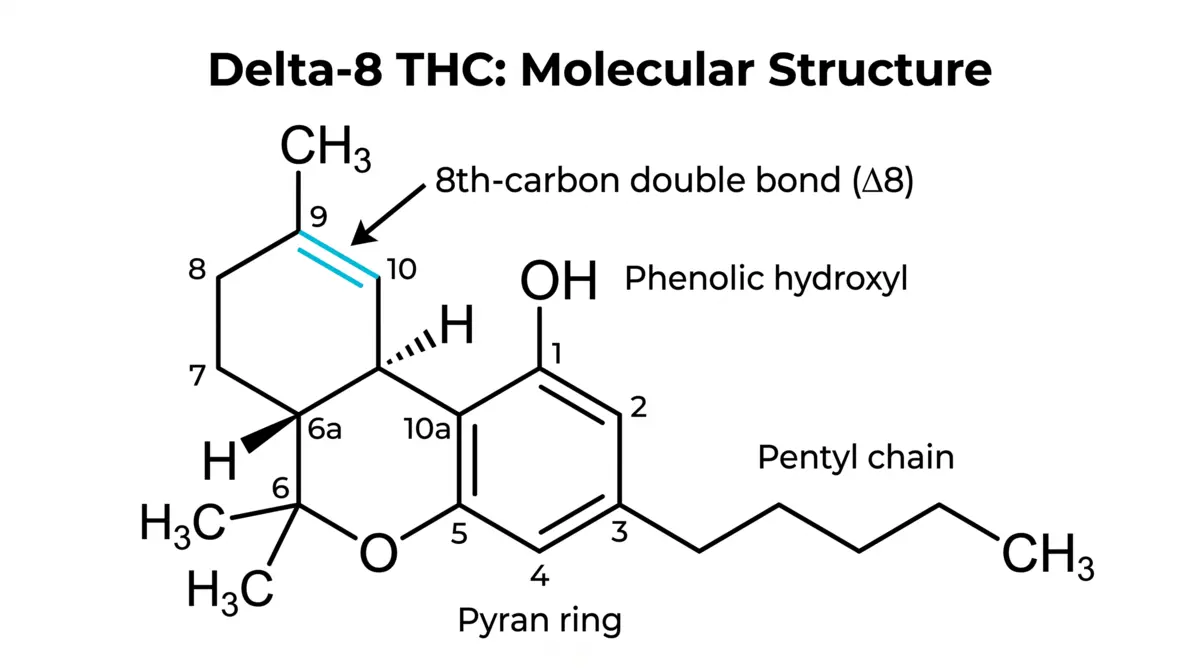
Delta-8 THC is a minor cannabinoid — a naturally occurring compound in the cannabis plant, found in very low concentrations (typically under 1% of the plant by weight). Chemically, it's a form of tetrahydrocannabinol, so yes, it's a real THC. It binds to the same receptors in your body as delta-9 THC, the cannabinoid most people mean when they just say "THC."
Because delta-8 occurs in such small amounts naturally, it's not economical to extract it directly from cannabis flower. Almost every delta-8 product on the market is manufactured — more on how that works in the next section.
Delta-8 sits in a broader family of cannabis-derived compounds that includes delta-9 THC, CBD, delta-10 THC, CBG, CBN, and dozens of others. If you want a primer on how cannabinoids work in your body, our explainer on THC vs. CBD covers the basics.

Where delta-8 THC actually comes from
The delta-8 story is really a story about a legal loophole and a chemistry process — not a story about the plant.
The 2018 Farm Bill opening
The Agriculture Improvement Act of 2018, known as the Farm Bill, legalized hemp federally by defining it as cannabis with no more than 0.3% delta-9 THC by dry weight. Hemp and its derivatives were carved out of the Controlled Substances Act. The bill was written around delta-9 THC specifically, so other cannabinoids derived from hemp — like CBD, and later delta-8 — sat outside the controlled-substance framework.
That wording created what Congressional Research Service analysts and the industry both came to call the "farm bill loophole." If you could make an intoxicating cannabinoid from hemp, and the final product contained less than 0.3% delta-9 THC, you could sell it in places regulated cannabis can't legally go.
Manufacturers spotted the opening, and delta-8 was the first major product to fill it.
How delta-8 is actually made
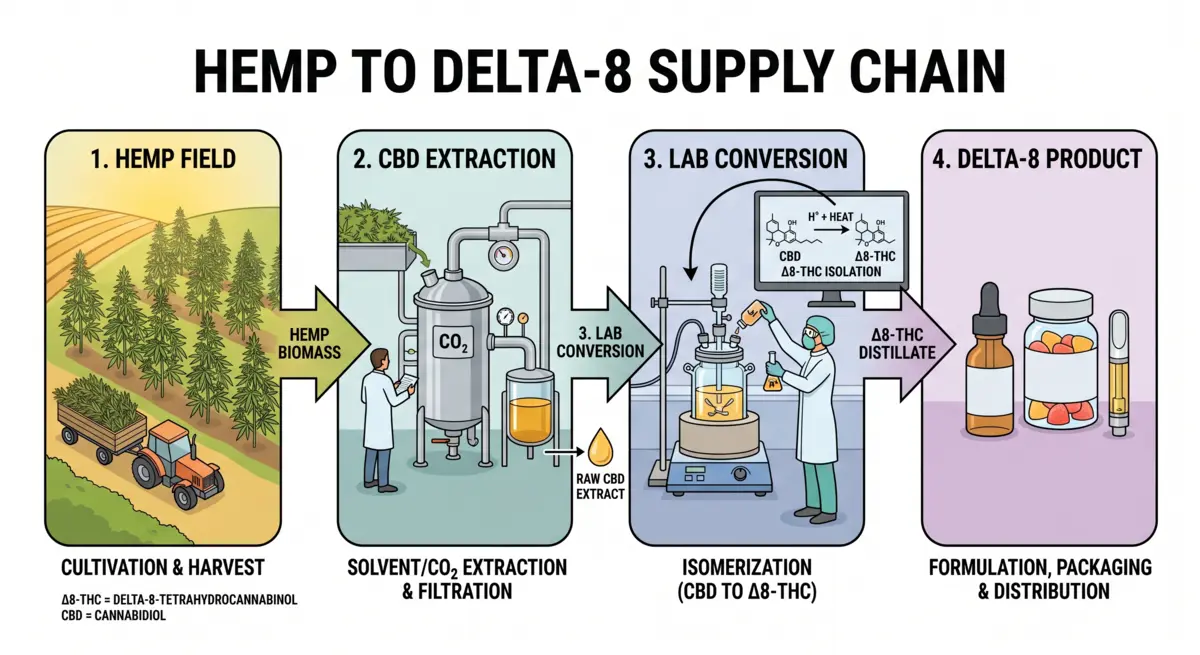
The natural amount of delta-8 in hemp is too small to harvest directly. Instead, manufacturers take CBD — which hemp produces in abundance — and chemically convert it into delta-8 through a process called isomerization.
The basic chemistry, described in peer-reviewed literature: CBD is dissolved in a solvent, an acid is added as a catalyst, and heat is applied for several hours. The acid triggers a reaction that rearranges the CBD molecule into delta-8 THC (with smaller amounts of delta-9 THC, delta-8-iso-THC, and other byproducts). The end product is purified, usually via distillation or chromatography, and sold as distillate or formulated into vapes, gummies, and other products.
Is delta-8 synthetic? The honest answer is "semi-synthetic." The starting material (CBD) is natural. The conversion is a human-directed chemical reaction that doesn't happen on its own in the plant. The FDA has pointed out that this process requires additional chemicals to produce the concentrations of delta-8 found in commercial products, and that those chemicals and reaction byproducts can end up in the final product if the manufacturer isn't careful.
This matters for two reasons: quality control and regulation. In a licensed cannabis program, delta-9 THC comes from the plant itself and is tested at every stage. Delta-8 made through isomerization has historically sat outside that framework — which sets up both the safety questions later in this guide and the gas station weed reputation.

Delta-8 THC vs. delta-9 THC: the key differences
Delta-8 and delta-9 are close cousins. Both are forms of THC. Both will get you high. But they differ in chemistry, how they're sourced, how they feel, and — most importantly — how they're regulated.
The chemistry, in plain English
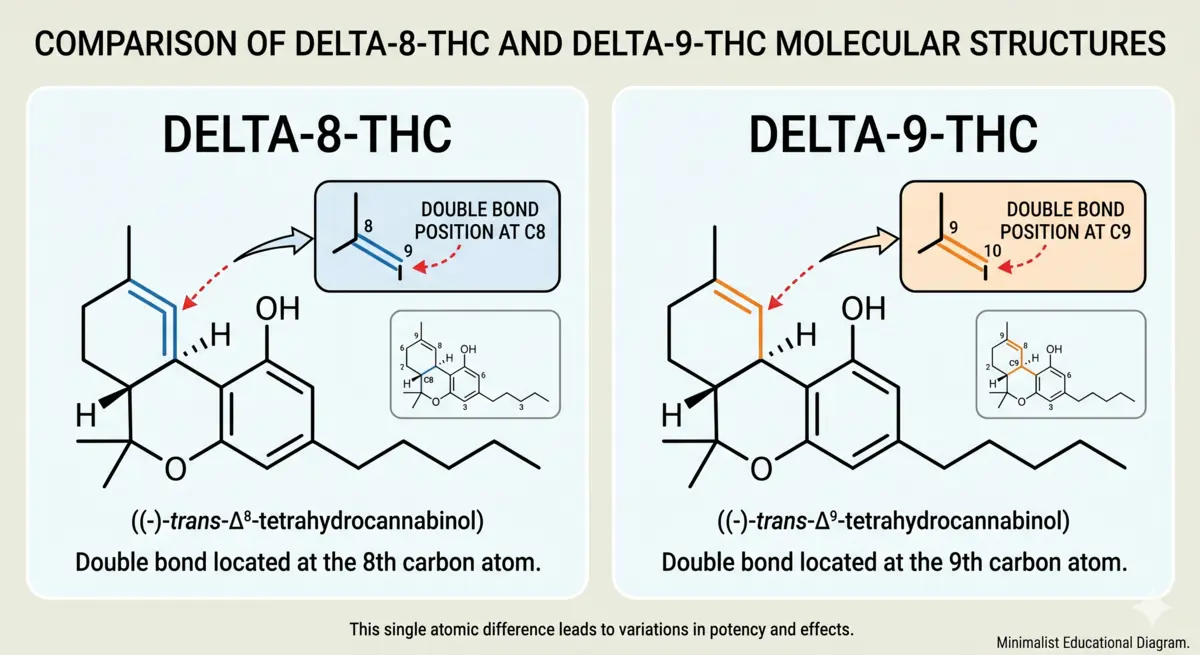
The two molecules are nearly identical. The only structural difference is the position of a single double bond: on the 9th carbon in delta-9 THC, on the 8th carbon in delta-8 THC. That tiny shift changes how each molecule fits into the CB1 receptors in your brain, which is why they feel different. A comprehensive comparative pharmacology review in the British Journal of Pharmacology describes delta-8 as a partial agonist at CB1 — it activates the receptor, just less efficiently than delta-9. Our page on the endocannabinoid system covers how these receptors work if you want the deeper explanation.
How the high compares
Reported effects overlap heavily, but most users describe delta-8 as milder, more functional, and less prone to producing anxiety or paranoia than delta-9. The Tagen and Klumpers pharmacology review concluded that the pharmacokinetic and pharmacodynamic profiles of delta-8 and delta-9 are broadly similar, with delta-8 showing reduced potency largely because of its weaker CB1 receptor binding.
An important caveat: human research on delta-8 is thin. A 2023 scoping review in Addiction found that most existing research on delta-8 uses animal or cell models rather than human subjects. "Milder" doesn't mean "safer," and the research is not mature enough to support strong claims in either direction.
How they're sourced
Delta-9 in a licensed dispensary comes from cannabis flower, extracted and processed under state-regulated conditions. Delta-8 in commercial products comes from hemp CBD converted in a lab.
Quick comparison
Natural abundance in cannabis: Delta-9 is the primary psychoactive cannabinoid and occurs in high concentrations in cannabis flower. Delta-8 occurs only in trace amounts, typically under 1%.
Typical source: Delta-9 is extracted from cannabis flower at licensed cultivators and processors. Delta-8 is almost always converted from hemp-derived CBD in a lab.
Potency: Delta-9 is stronger and more psychoactive. Delta-8 is typically milder, often described as more functional or body-leaning.
Federal status: Delta-9 is federally controlled but legal in specific state programs. Delta-8 sits in a federal gray zone that is narrowing under P.L. 119-37.
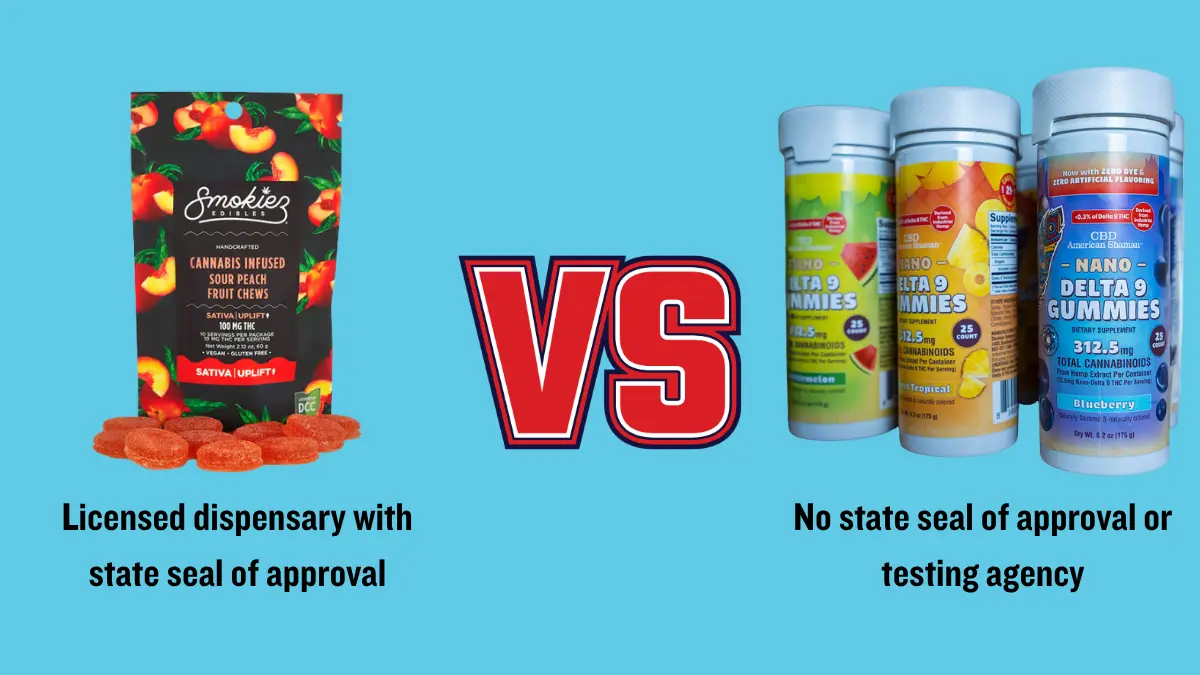
Regulation and testing: Delta-9 sold at licensed dispensaries is lab-tested, accurately labeled, and age-gated. Delta-8 is largely unregulated at the federal level, with state laws that vary widely.
Where you find it: Delta-9 is sold at licensed dispensaries. Delta-8 is commonly sold at gas stations, smoke shops, and online retailers.

What does delta-8 THC feel like?
Delta-8 produces a psychoactive high, but most users describe it as lighter than delta-9. Commonly reported effects include mild euphoria, relaxation, some body heaviness, and appetite stimulation. Many users describe feeling clearer-headed than they do on delta-9.
Commonly reported side effects track closely with delta-9 THC: dry mouth, red eyes, drowsiness, elevated heart rate, dizziness, and — at higher doses — confusion or anxiety. A concern specific to delta-8, flagged by the FDA: some reported adverse events may stem from contaminants or byproducts in the manufacturing process rather than from delta-8 itself. We dig into that in the next section.
How long delta-8 effects last
Duration depends on how you consume it. Inhaled delta-8 (vapes or flower sprayed with distillate) typically peaks within minutes and wears off in a couple of hours. Edible delta-8 takes 30 to 90 minutes to onset and can last 4 to 8 hours. Our guide to how long a cannabis high lasts breaks down the timelines for different consumption methods in more detail — the patterns for delta-8 follow the same general rules.
If you're considering an edible for the first time, the edibles dosage guide is worth reading before you do anything. The guidance there is written for regulated delta-9 products, but the core principles — start low, go slow, wait for onset before re-dosing — apply to any form of THC.
Is delta-8 THC safe?
Delta-8 itself, at comparable doses, isn't known to be inherently more dangerous than delta-9. The safety concerns around delta-8 are mostly about how the products are made and sold — not the molecule in isolation.
Contamination from the manufacturing process
The CBD-to-delta-8 conversion uses acids and solvents. When it's done carefully in a qualified lab, the byproducts can be controlled. When it's not, residual chemicals and unintended reaction products can end up in the final product. The FDA has specifically flagged concern about potentially harmful chemicals being used in some delta-8 manufacturing and showing up as contaminants.
Independent analyses have repeatedly found delta-8 products whose contents don't match their labels — different cannabinoid ratios, unlisted compounds, inconsistent potency.
The testing and labeling gap
In states with legal cannabis programs, every product has to clear mandatory testing: potency, pesticides, heavy metals, residual solvents, microbial contamination. None of that is federally required for hemp-derived delta-8. Some states have filled the gap by regulating delta-8 under their own hemp or cannabis rules, but many haven't, and the testing landscape varies dramatically.
What the adverse event data shows
Between December 2020 and February 2022, the FDA received 104 adverse event reports from people who consumed delta-8 products. More than half required medical intervention or hospitalization. Reported effects included hallucinations, vomiting, tremor, anxiety, dizziness, confusion, and loss of consciousness. During a similar window, national poison control centers logged 2,362 exposure cases involving delta-8 products — and 41% of those cases involved patients under 18, many of them accidental exposures to products packaged to look like candy or snacks.
Who should be especially cautious
Anyone trying cannabis for the first time, anyone with a cardiovascular condition, anyone on prescription medications, and anyone pregnant or breastfeeding should avoid delta-8 — the same caution that applies to any THC product, plus the added unknown of what's actually in a specific unregulated product. Keep delta-8 products out of reach of children and pets, always.
Why people call it "gas station weed"
The nickname is descriptive, not dismissive. Delta-8 earned the label "gas station weed" because that's where a lot of it ended up being sold — gas stations, convenience stores, smoke shops, vape shops, and online retailers. Places that don't sell regulated delta-9 cannabis, can't legally sell regulated delta-9 cannabis, and don't operate under the licensing, testing, and staff-training requirements that regulated dispensaries do.
What that means practically: a gas station clerk isn't a budtender. The product on the shelf probably wasn't lab-tested by an independent third party. Age verification is inconsistent. Labeling may not match contents. The person selling it to you can't help you figure out what dose is appropriate because that isn't their job.
None of this means delta-8 is "fake THC" or that it can't get you high — it can, and it does. The point is that the retail environment delta-8 ended up in is genuinely different from a licensed cannabis program, and that difference shows up in product quality, consumer protection, and how much you can trust what's on the label.

Is delta-8 THC legal?
Delta-8's legal status is the most complicated part of this story, and it's actively changing. The short version: delta-8 operated in a federal gray zone from 2019 through 2025, and a 2025 law is set to close that gray zone at the federal level in late 2026.
The federal picture
The 2018 Farm Bill's definition of hemp only referenced delta-9 THC, which is how delta-8 products became federally available in the first place. In November 2025, Congress passed and President Trump signed P.L. 119-37, which amends the hemp definition to use a "total THC" standard (including THCA and other THC variants), caps finished hemp-derived cannabinoid products at 0.4 milligrams of total THC per container, and explicitly excludes synthesized or manufactured cannabinoids. The effective date is November 12, 2026. When that takes effect, most delta-8 products currently on the market will no longer fit the federal hemp definition.
There are pending bills that would delay, modify, or repeal P.L. 119-37, so the specifics could shift between now and the effective date. The broader direction — federal regulators narrowing the loophole — is the stable story.
The state patchwork
Even before the federal changes, state treatment of delta-8 has varied widely. Some states banned delta-8 outright. Some regulated it under their hemp rules. Some regulated it under their cannabis programs. Others left it in a gray zone of their own. State laws also frequently change, and state-level restrictions often preempt or contradict what's federally allowed.
Bottom line: If you're trying to figure out whether delta-8 is legal in your specific state, check current state regulations from a reliable source. Laws change, and generalizations from a national guide won't substitute for checking your jurisdiction. If you're in Ohio or Maryland, our state hubs cover what's currently legal where Bloom operates.
Delta-8 THC and drug tests
Short answer: yes, delta-8 will very likely cause a positive result on a standard drug test. Don't use delta-8 if you're subject to drug testing.
Why delta-8 triggers drug tests
Standard urine drug tests don't look for delta-9 THC directly. They screen for THC-COOH, a metabolite produced when your body processes any form of THC. Delta-8 metabolizes into very similar compounds, and most drug tests aren't sophisticated enough to tell delta-8 metabolites apart from delta-9 metabolites. A positive is a positive, regardless of which form of THC you consumed.
How long delta-8 stays in your system
Detection windows for delta-8 track closely with delta-9 and depend on the same variables: how frequently you use, body composition, metabolism, dose, and the test being used.
General ranges:
Urine: Occasional use may clear in about 3 to 7 days. Regular use can show up for 2 to 6 weeks. Heavy daily use can detect even longer.
Blood: Generally detectable for hours to a few days, longer with heavy use.
Saliva: Typically up to 24–72 hours.
Hair follicle: Up to about 90 days.
These are general guidelines, not promises — individual variation is significant.
Marketing claims you should ignore
"Hemp-derived," "federally legal," "won't show up on a drug test," and similar claims on delta-8 packaging are not reliable indicators of drug test outcomes. The metabolism is the metabolism regardless of where the THC came from. If your job, probation, athletic organization, or legal situation requires clean drug tests, avoid delta-8.
How delta-8 compares to other cannabinoids
Delta-8 isn't the only hemp-derived cannabinoid that's popped up in retail. Here's how it stacks up against the ones you're most likely to see on shelves or in comparison searches.
Delta-8 vs. CBD
CBD is non-intoxicating. It doesn't get you high. Delta-8 is intoxicating — it does. Both can be hemp-derived, but they produce completely different experiences. People reach for CBD for wellness reasons (sleep, stress, discomfort); people reach for delta-8 for a mild high. Our THC vs. CBD guide has more on how CBD differs from THC compounds generally.
Delta-8 vs. HHC
HHC (hexahydrocannabinol) is another hemp-derived cannabinoid, made by hydrogenating THC. It's less studied than delta-8, but the same regulatory questions and manufacturing concerns apply — and the new federal hemp definition under P.L. 119-37 puts HHC in the same narrowing position as delta-8.
Delta-8 vs. delta-10
Delta-10 is another minor THC variant, also typically produced by converting hemp CBD. Users generally report delta-10 as lighter and more uplifting than delta-8, but published research is even thinner. The same regulation and quality caveats apply.
Delta-8 vs. delta-9 (from licensed dispensaries)
If delta-9 from a regulated dispensary is available to you legally, that's a different product category entirely — tested, labeled, age-gated, and sold by staff trained to help you choose. Most of the safety concerns around delta-8 are about the unregulated retail environment, not about THC itself.
Why Bloom sells regulated delta-9 THC instead
We're a licensed dispensary operator, and we've built our business around regulated cannabis for a pretty simple reason: it's a better product category for the customer.
Here's what regulation actually gets you, and why we think it matters:
Lab testing. Every product sold through a licensed cannabis program has to pass testing for potency, pesticides, heavy metals, residual solvents, and microbial contamination. You know what's in the product because a third-party lab verified it.
Accurate labeling. The milligram count on the package is the milligram count in the product. Full panel results are available on request or on the packaging.
Age-gated sales. You can't walk into a licensed dispensary as a minor. Staff verify ID every time.
Trained staff. Our budtenders can actually help you figure out what you're picking up — format, potency, expected onset, how it might interact with what you already use. That's the job, and it's the job precisely because cannabis rewards a little guidance.
Chain of custody. From licensed cultivator to licensed processor to licensed retailer, every step is tracked. Product recalls, when they happen, can actually reach the product.
Delta-8 exists because of a legal workaround, not because cannabis consumers or the cannabis industry decided it was a better product than regulated delta-9. We're not saying everyone who's tried delta-8 was wrong to try it — plenty of people in states without legal cannabis have reached for it as the only thing available. We're saying: if you have access to a licensed dispensary, that's what a dispensary is for.
If you're in Ohio, you can find us across the state at locations listed on our Ohio hub, or read through what to expect on a first dispensary visit if you're new. If you're in Maryland, come see us at our Germantown dispensary.
Frequently asked questions
Does delta-8 get you high?
Yes. Delta-8 is a psychoactive form of THC. The high is typically milder than delta-9, but it's a real high with real intoxicating effects. Don't drive or operate machinery after consuming it.
Is delta-8 THC the same as THC?
Delta-8 is a form of THC — it's tetrahydrocannabinol, just a different isomer than delta-9. When most people say "THC" in casual conversation, they mean delta-9 specifically, but both are THC.
Will delta-8 show up on a drug test?
Almost certainly, yes. Standard drug tests detect THC metabolites without distinguishing between delta-8 and delta-9. If you're subject to drug testing, avoid delta-8.
Is delta-8 natural or synthetic?
Semi-synthetic. Delta-8 exists naturally in the cannabis plant in trace amounts, but virtually all commercial delta-8 is produced by chemically converting hemp-derived CBD in a lab. The starting material is natural; the finished product is the result of a human-directed chemical reaction.
Is delta-8 safer than delta-9?
Not in a clear-cut way. The molecule itself isn't dramatically more dangerous at comparable doses, but most commercial delta-8 products are made and sold outside the regulatory framework that applies to licensed cannabis. So the practical safety question is less about the molecule and more about the product and the retailer.
How much delta-8 should I take?
General guidance: start low, go slow, wait for onset before re-dosing — the same principles that apply to any THC product. But dosing specifics for delta-8 are complicated by inconsistent labeling on unregulated products. Our edibles dosage guide covers dosing principles for regulated delta-9 edibles, which is a more predictable starting point.
Can I travel with delta-8?
Legally complicated and varies by jurisdiction. Federal airport security and state laws at your destination matter. Given the changes to federal hemp law effective November 2026, this question is likely to become more complicated, not less. Not recommended.