
Decarboxylation: The Science of Activating Cannabis
Raw cannabis doesn't get you high. You can eat an entire fresh bud off the plant and feel almost nothing. That's because the cannabis plant doesn't produce THC directly — it produces THCA, an acidic precursor that has to be transformed through a process called decarboxylation before it becomes psychoactive. Decarboxylation is the invisible step between cannabis and every edible, tincture, or smoking experience you've ever had. Once you understand it, everything about cannabis chemistry makes more sense.
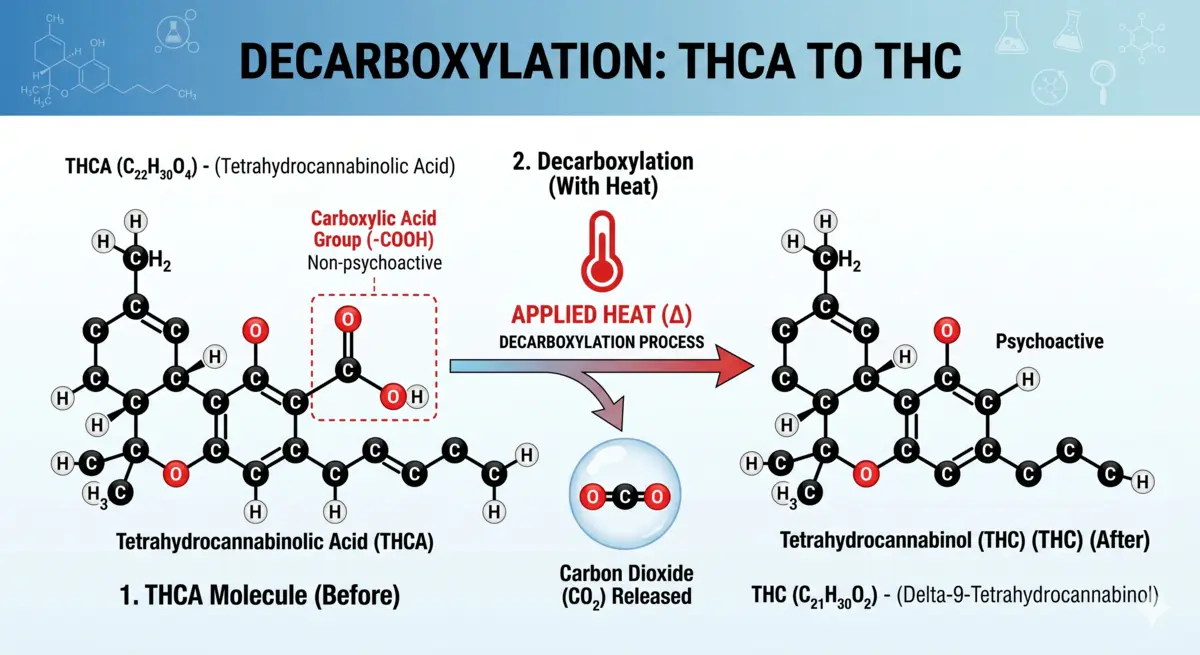
Diagram showing THCA molecule losing a CO2 group to become THC with heat applied.
What Is Decarboxylation?
Decarboxylation — "decarb" for short — is a chemical reaction in which a carboxyl group (a group of carbon, oxygen, and hydrogen atoms that makes a molecule acidic) is removed from a molecule and released as carbon dioxide. In cannabis, this reaction converts the acidic forms of cannabinoids into their active, neutral forms:
THCA → THC (psychoactive)
CBDA → CBD (non-psychoactive, but more bioavailable in its active form)
CBGA → CBG
CBCA → CBC
The reaction is driven primarily by heat and time. Small amounts of decarboxylation happen slowly at room temperature over months or years. Much more happens quickly at higher temperatures — which is exactly what happens when you light a joint, heat a dry-herb vaporizer, or bake cannabis in an oven.
Why Raw Cannabis Doesn't Get You High
THCA, the acidic precursor, doesn't bind well to the CB1 receptors in your brain the way THC does. The carboxyl group gets in the way. Only once that group is knocked off — through heat — does the molecule become shaped correctly to produce intoxicating effects. This is why eating raw cannabis produces almost no high and why making edibles from unheated cannabis simply doesn't work (Wang et al., 2016, Cannabis and Cannabinoid Research).
THCA itself isn't useless — preliminary research suggests it has its own effects on inflammation and neuroprotection — but it's not psychoactive. For more on the range of cannabinoids, see our guide to major vs minor cannabinoids.
When Decarboxylation Happens Automatically
You don't have to manually decarboxylate cannabis every time you use it. Most consumption methods do it for you:
Smoking: Combustion instantly decarbs and vaporizes the cannabinoids. No manual prep needed.
Vaping: Temperature-controlled vaporization decarbs and releases cannabinoids in a single step.
Dabbing: Concentrates are typically pre-decarboxylated, so they work immediately.
Most commercial edibles: Manufacturers pre-decarb the cannabis before infusing it into the final product.
When You Need to Manually Decarboxylate
Manual decarboxylation matters when you're making cannabis products at home:
Infusing butter or oil for homemade edibles or cooking.
Making tinctures with flower as the starting material.
Making capsules or encapsulated oils.
Making cannabis tea or other infusions where you expect the full effect.
How to Decarboxylate Cannabis at Home
There are a few methods. The oven method is the simplest and most reliable.
The Oven Method
1. Preheat oven to 240°F (115°C). This is the sweet spot for efficient decarboxylation without significant terpene loss.
2. Break up your flower into small, roughly-equal pieces. Don't grind to a powder — too fine increases surface area too much.
3. Spread on a parchment-lined baking sheet in a single layer.
4. Bake for 30–40 minutes. The cannabis should turn from bright green to light golden brown. Check at 30 minutes.
5. Let it cool completely before using — the cannabis continues to dry as it cools.
Lower-Temperature Alternative
Some people prefer to decarb at 220°F (104°C) for 60 minutes. This preserves more terpenes but takes longer. Either method works — the longer, lower approach retains more flavor and aroma, the shorter, hotter approach is faster and slightly more efficient.
Sous Vide Method
For maximum terpene preservation, seal cannabis in a vacuum-sealed bag and cook in a sous vide water bath at 203°F (95°C) for 90 minutes. No smell escapes into the house, and the precise temperature avoids overshooting.
Temperature and Time: The Science
Cannabinoid activation vs. terpene preservation is a balance. Different temperatures produce different trade-offs:
220°F / 60 minutes: Best terpene preservation, slower activation.
240°F / 30–40 minutes: Good balance of activation and flavor.
250°F / 25–30 minutes: Faster but more terpene loss.
Above 310°F: Begins to degrade THC itself into CBN. Avoid.
Terpenes start evaporating around 310°F (154°C), which is why dry-herb vaporizers often let you choose temperatures in that range depending on whether you want to prioritize cannabinoids or flavor. For more on terpenes, see our cannabis terpenes guide.
How to Tell If It Worked
Color: Light golden brown, not dark brown or burned.
Smell: Earthy and toasted, but not acrid. Most of the bright terpene aroma will have faded — that's normal.
Texture: Dry and slightly crumbly, easy to work with.
Accuracy matters most for high-end cooking. If you need lab-grade precision, some commercial devices are specifically designed for home decarboxylation and take the guesswork out.
What to Do After Decarboxylation
Decarbed cannabis is ready to be infused into a fat (butter, coconut oil, olive oil) for cooking, or into alcohol for a tincture. For full infusion and cooking instructions, see our cooking with cannabis guide. You can also use decarbed flower directly — for example, sprinkled into a recipe — though the flavor will be pronounced.
Frequently Asked Questions
Do I have to decarboxylate cannabis before making edibles?
Yes, if you want full potency. Undecarbed cannabis in edibles will produce very weak effects because THCA isn't psychoactive. Some infusion processes provide partial decarboxylation through cooking heat, but a dedicated decarb step produces much better results.
Can you decarboxylate cannabis in a microwave?
Not reliably. Microwaves heat unevenly and are hard to control. Stick to the oven or sous vide methods.
How long does decarbed cannabis stay fresh?
Similar to regular cannabis — if stored airtight, cool, and dark, it lasts several months. Decarbed cannabis loses flavor faster than fresh flower because most of the terpenes are already gone.
Does decarbing work on concentrates?
It can, but many concentrates are already decarbed. Check the product. If making edibles from an undecarbed extract, heat it gently (around 240°F) for 15–20 minutes.
Can I decarboxylate cannabis in butter or oil?
Partially. Long simmering in fat provides some decarboxylation, but it's less efficient and less complete than a dedicated decarb step in the oven. The best approach is decarb first, infuse second.
Will decarboxylation destroy terpenes?
Some, yes. Terpenes are volatile and begin evaporating below the temperatures required for full decarboxylation. Lower-temperature methods (like sous vide) preserve more terpenes; oven methods preserve fewer.
The Bottom Line
Decarboxylation is the chemistry behind every cannabis experience. It happens automatically when you smoke or vape, and it's the essential first step if you're making edibles, tinctures, or capsules at home. Thirty minutes in a 240°F oven is all it takes. Once you've got decarbed cannabis, the rest of cannabis cooking becomes straightforward.
Shop flower for infusion at Bloom Ohio or Bloom Maryland.