What Are THC Drinks? A Complete Guide to Cannabis Beverages
THC drinks are one of the fastest-growing categories in cannabis — and one of the most misunderstood. In the last few years, seltzers, sodas, teas, and mocktails infused with THC have moved from niche dispensary shelves into national conversation, driven by the rise of the sober curious movement and better drink formulations that actually work.
If you're new to cannabis beverages, or you've tried one and want to understand what's happening in the can, this guide covers it all: how THC drinks work, how they compare to edibles and alcohol, what the different formats are, how to dose them, and what to look for on a label. It's written for both cannabis newcomers and experienced consumers who want a clear, no-hype breakdown of the category.

What are THC drinks?
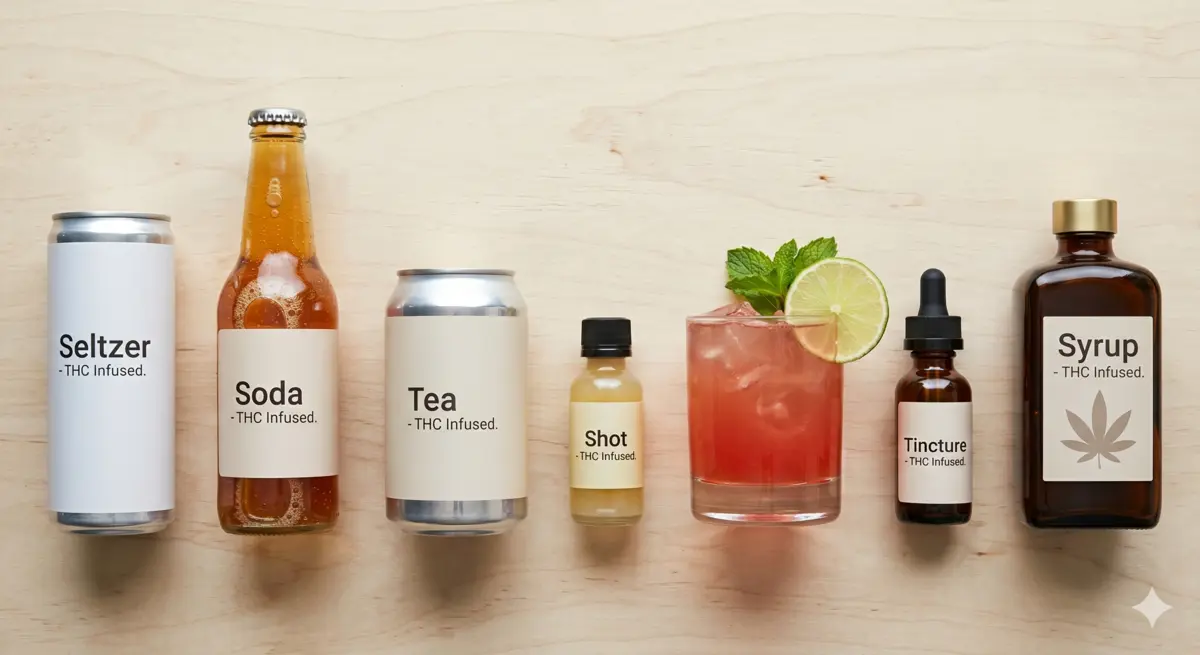
THC drinks are beverages infused with THC (tetrahydrocannabinol), the compound in cannabis that produces a high. The category covers a wide range — seltzers, sodas, teas, shots, ready-to-drink mocktails, and liquid tinctures you add to other beverages yourself.
Some THC drinks also include CBD (cannabidiol) or minor cannabinoids like CBN. The dose per container typically ranges from around 2 milligrams of THC on the low end to 10 milligrams or more on the higher end, though exact amounts vary by product and local regulations.
Unlike flower or vapes, THC drinks don't involve inhaling anything. That's a big part of the appeal for people who want to try cannabis but don't want to smoke — which is one reason this category has grown so quickly.
How do THC drinks work?
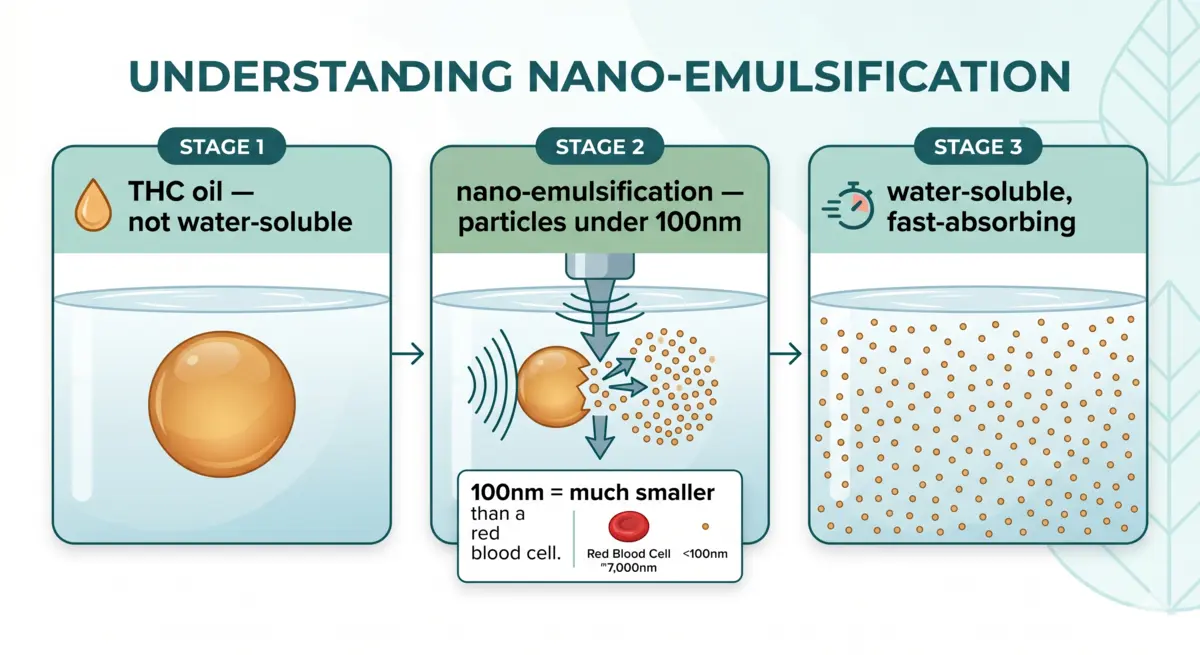
THC is fat-soluble. That's a problem for a drink, because oil and water don't mix. Pour plain cannabis oil into a seltzer and it will float on top in an oily slick.
Modern THC drink makers solve this with a process called nano-emulsification. It breaks THC particles down to a tiny scale — usually under 100 nanometers — and coats them so they disperse evenly through water. The result is a clear, stable drink and, more importantly, a THC molecule your body can absorb faster than a typical edible.
Here's the short version of what happens after you take a sip:
Some of the THC enters your bloodstream through the tissues in your mouth (sublingual or oromucosal absorption)
The rest passes through your digestive system and liver, similar to how traditional edibles are processed
Because nano-emulsified THC is smaller and more water-soluble, both pathways are faster and more efficient than with a regular gummy or chocolate
Not every THC drink on the market is nano-emulsified. Products that aren't will behave more like traditional cannabis edibles — longer onset, longer duration. The label or product description should tell you. We'll cover what to look for a little later.

How long do THC drinks take to kick in?
Most nano-emulsified THC drinks start to take effect within 15 minutes, with many people reporting the first sensations at around 10 to 20 minutes. Non-nano drinks take longer — typically 30 to 90 minutes, similar to a gummy or chocolate.
A few factors affect how quickly you'll feel a drink:
Whether it's nano-emulsified (the biggest single factor)
Whether you've eaten recently — a drink on an empty stomach often hits faster
Your body chemistry — metabolism, body weight, and cannabis tolerance all play a role
How much you drink at once — a 2mg sip lands differently than a 10mg can in one go
The fast onset is the single biggest thing that distinguishes THC drinks from other edibles. With a gummy, you take it and wait 45 minutes wondering if it worked. With a nano-emulsified seltzer, you usually know within half a sitcom episode.
How long do the effects last?
Expect effects from a THC drink to last roughly 2 to 4 hours, depending on dose, tolerance, and individual metabolism. Residual effects — feeling a little relaxed or heavy-lidded — can linger a bit longer, especially with higher doses.
That's shorter than a typical edible, which can last 4 to 8 hours or more. The shorter duration is part of why THC drinks have gained traction as an alcohol alternative: the window lines up more naturally with a dinner, a social event, or a night in. For a deeper breakdown of how long a cannabis high lasts across different formats, see our guide on how long a cannabis high lasts.
As with any form of cannabis, duration is highly individual. A light cannabis consumer might feel a 5mg drink for three hours; a regular consumer might barely notice it. Start low until you know how your body responds.
What do THC drinks feel like?
The honest answer is: it depends on the dose, the product, and you. Here's what most people report.
At a low dose (2.5 to 5mg), many people feel a mild, easy lift — more social, a little more relaxed, maybe slightly more present with what they're doing. It's closer to a glass of wine than a heavy edible.
At a moderate dose (5 to 10mg), the effects are more noticeable. You might feel pleasantly buzzed, euphoric, or sedated depending on the product and the cannabinoid blend used.
At higher doses (10mg and up), effects deepen — and for less experienced consumers, can tip into uncomfortable territory like anxiety, racing thoughts, or couch-lock. The advantage of a drink is that you can sip slowly and stop when you've had enough.
The experience also depends heavily on what cannabinoids and terpenes are in the drink. A product with THC and CBD together often feels mellower than THC alone. A product formulated for uplifting effects will typically contain terpenes associated with that feel.
If you're new to cannabis or new to edibles, plan your first THC drink for a low-stakes setting — at home, with people you trust, without anywhere you need to be.
THC drinks vs. alcohol
One of the biggest reasons THC drinks have taken off is that a lot of people are looking for an alternative to alcohol. Here's how the two actually compare.
What's similar:
Both can create a relaxed, sociable feeling
Both come in familiar formats — cans, bottles, mixed drinks
Both are consumed socially, often in the same settings
What's different:
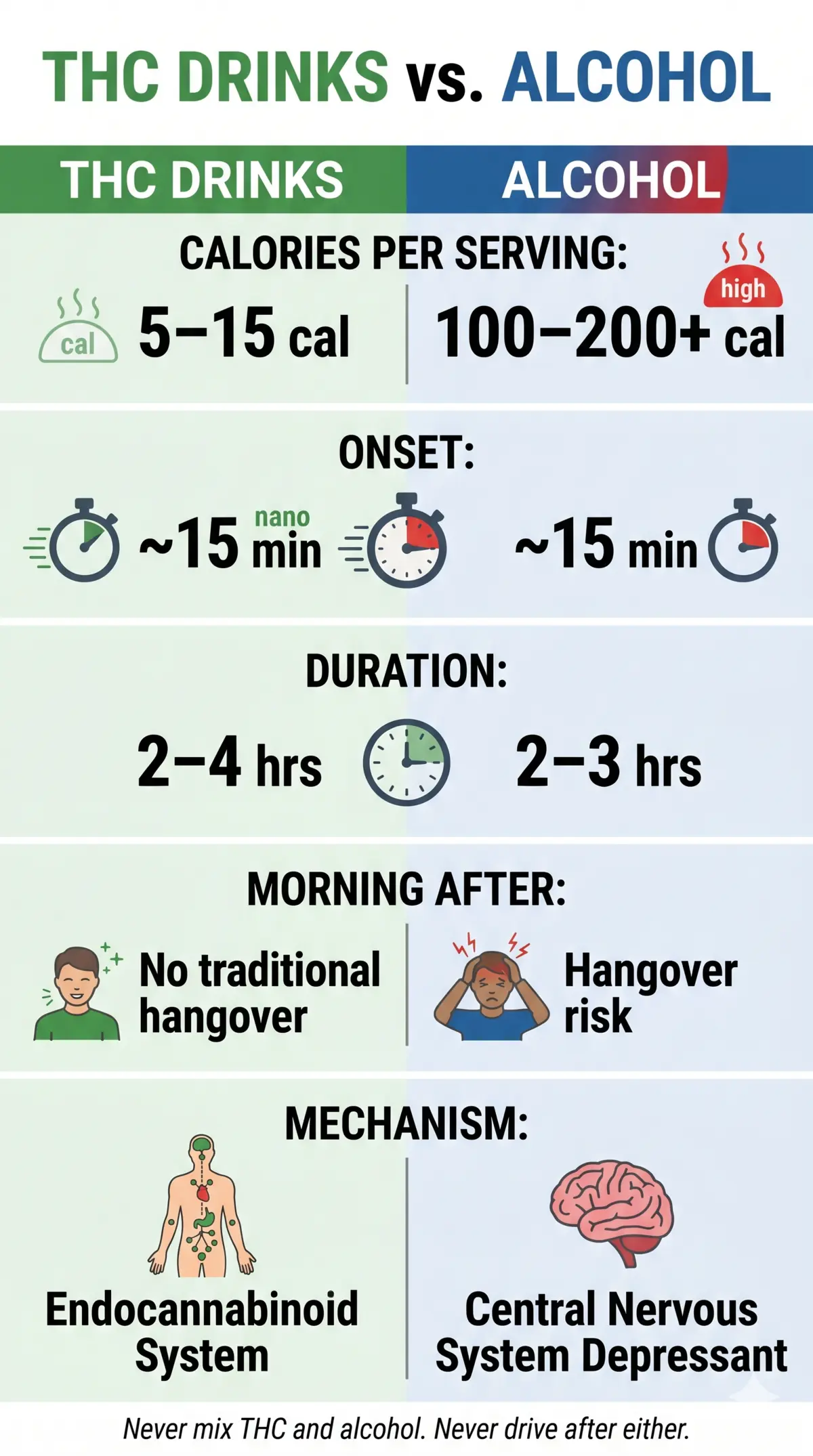
Calories. A typical THC seltzer runs 5 to 15 calories. A light beer is around 100, a glass of wine around 125, a cocktail often 200 or more.
Hangover. Most people don't experience a traditional hangover from a THC drink. You can feel foggy or tired the next day after a high dose, but not the dehydration-and-nausea pattern alcohol creates.
Mechanism. Alcohol is a central nervous system depressant that affects nearly every organ system. THC works on the endocannabinoid system, a network of receptors involved in mood, appetite, and pain perception, among other things. They're completely different processes.
Dose control. An alcoholic drink has a relatively predictable effect per serving. THC affects people differently based on tolerance, body chemistry, and product type. A 5mg drink might do much more to a new consumer than to a regular one.
Impairment. Both can impair coordination and judgment. You should never drive after either, and you shouldn't mix them — combining alcohol and THC amplifies the effects of each in ways that are hard to predict.
If you're considering swapping alcohol for THC drinks, the shift isn't one-for-one. A can of seltzer with 5mg of THC is not the same as a glass of wine, and it won't make you feel the same way. Treat it as a different experience that fits similar social moments, not a direct substitute.

THC drinks vs. edibles
THC drinks are technically a type of edible, but they behave differently from gummies, chocolates, and baked goods in a few important ways.
Onset is faster. Nano-emulsified drinks typically kick in within 15 minutes. Gummies and chocolates usually take 30 to 90 minutes, sometimes longer.
Duration is shorter. Drinks usually last 2 to 4 hours; traditional edibles last 4 to 8.
Dose control is easier. A can is a fixed serving. Even better, you can sip a 10mg can over an hour and stop partway through — something harder to do with a gummy you've already chewed.
They're more social. A can or glass fits into a dinner, a party, or a happy hour without drawing attention the way a brownie might.
Calorie and sugar content varies. Many traditional edibles (especially gummies and chocolates) are sugar-heavy. Drinks can be too — but seltzers and many low-sugar options are widely available.
For people who've had bad experiences with edibles in the past — waiting too long, eating more because they thought the first one wasn't working, and then getting hit harder than they wanted — drinks often solve the core problem. You feel it fast enough to know it's working.

The category has expanded a lot in the last few years. Here are the main formats you'll see on a dispensary shelf.
THC seltzers are lightly flavored, carbonated, and usually low-calorie — the most popular format in the category right now. Think of them as the cannabis equivalent of a hard seltzer. Most contain 2 to 10mg of THC per can, often with a small amount of CBD.
THC sodas are similar to seltzers but sweeter and more flavorful, closer to a traditional soft drink. Usually higher in calories and sugar than seltzers.
THC teas and coffees are tea or coffee infused with THC, sometimes combined with CBD or small amounts of caffeine. Popular with people who want a more subtle, functional use case — afternoon relaxation, morning creativity.
THC shots are concentrated liquid, usually 1 to 2 ounces, containing a larger dose in a small volume. Meant to be drunk quickly or added to another beverage.
THC mocktails and ready-to-drink cocktails are pre-mixed non-alcoholic cocktails with THC instead of alcohol. Aimed at the sober curious crowd: familiar cocktail flavors (margaritas, palomas, negronis) without the booze.
THC tinctures and liquid drops for drinks are dropper bottles of THC-infused liquid you add to your own drinks. Gives you full control over the dose and lets you turn any beverage into a THC drink. Most tinctures aren't nano-emulsified, so expect slower onset.
THC syrups are thicker, sweeter liquids meant to be mixed into other drinks or drizzled over food. Often higher potency per serving than ready-to-drink options.
Which format is right for you comes down to dose, calories, caffeine, and how you want to drink it. A seltzer and a syrup both deliver THC, but they fit very different moments.
How to dose THC drinks
If you take one thing from this guide, take this: start low, go slow, and don't stack.
Here's what that looks like in practice:
First time with a THC drink? Start with 2.5mg or lower. Many products are sold in microdose sizes for exactly this reason.
Some cannabis experience? 5mg is a reasonable starting serving.
Experienced consumer? 10mg and up is the standard moderate-to-higher range.
Wait at least 30 minutes before having more, even with a fast-onset drink. Nano-emulsification speeds onset, but it doesn't eliminate the ramp-up. Drinking a second can before the first has peaked is how people end up uncomfortably high. For a fuller breakdown on how to calibrate an edible dose over time, see our cannabis edibles dosage guide.
A few other dosing habits worth building:
Sip, don't chug. A can meant to be drunk over 30 minutes will feel different from the same can drunk in two minutes.
Read the whole label. Some products list total THC for the bottle, not per serving. A 10mg bottle labeled "2 servings" means 5mg per serving.
Eat first, especially the first few times. Food slows absorption slightly and can reduce the chance of feeling queasy.
Don't mix with alcohol. The combination is stronger and more unpredictable than either on its own.
If you're using THC drinks for sleep, relaxation, or a specific wellness purpose, building up slowly over several sessions helps you find your actual sweet spot rather than overshooting.

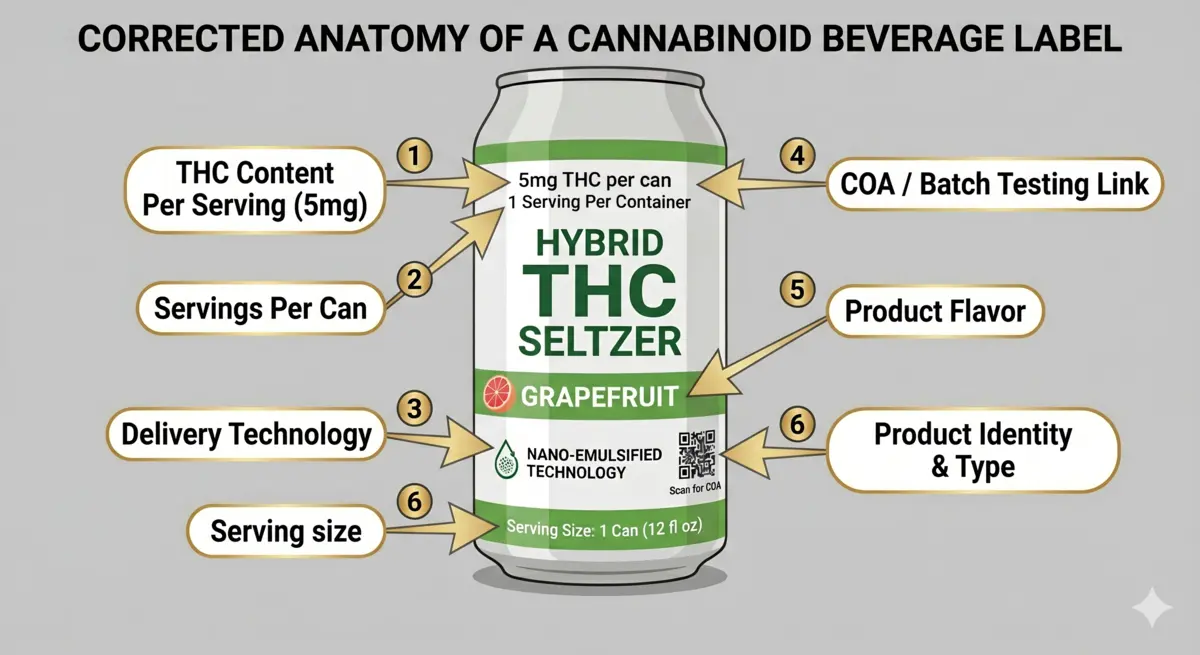
Not all THC drinks are made the same way, and label quality varies. When you're shopping, look for:
Dose per serving and per container. Should be clearly listed. Be careful — some single-serve-looking bottles are actually multi-dose.
Whether it's nano-emulsified or fast-acting. Usually stated explicitly; sometimes described as "rapid onset" or "water-soluble."
Cannabinoid profile. THC only, or THC plus CBD, CBN, or others? A 5mg THC + 5mg CBD drink will feel different from a 10mg THC drink. Our guide on THC vs. CBD has more on how these compounds differ and work together.
Sugar and calorie content. Seltzers are usually low; sodas and syrups can be high.
Caffeine, if any. Common in THC coffees and some sodas.
Third-party lab testing (COA). The best brands publish a Certificate of Analysis showing what's actually in the product. This is your best protection against inaccurate dose claims.
Ingredient list. Real fruit juice, natural flavors, and recognizable ingredients are a better sign than a wall of unpronounceable additives.
Our budtenders are a good shortcut here — they've tried most of what's on the shelf and can point you to a product that matches the dose and experience you're after.
Who are THC drinks for?
THC drinks appeal to a wider audience than most cannabis products. Common use cases include:
The sober curious. People cutting back on alcohol or skipping it entirely who still want a social, relaxing beverage.
First-time cannabis consumers. The familiar format and controlled dose make drinks a low-friction way to try cannabis for the first time.
People exploring edibles again after a bad experience. Drinks' faster onset makes them easier to dose than traditional gummies or chocolates.
Cannabis patients exploring alternatives to smoking or vaping, especially for conditions where inhalation isn't practical or preferred.
Social drinkers who want to be at a party or dinner with something in hand that isn't alcohol and isn't a non-alcoholic beer.
Consumers interested in microdosing cannabis — the controlled, sip-able format makes drinks a natural fit for keeping doses small and even.
THC drinks are probably not the best fit if you need high-dose, long-duration effects (a traditional edible may serve you better), if you're looking for the fast, intense onset of inhaled cannabis, or if you're someone who doesn't respond well to oral THC in any form.
Are THC drinks safe?
For healthy adults in states where cannabis is legal, THC drinks consumed responsibly are generally considered well-tolerated. That said, there are real considerations worth knowing.
Standard cautions that apply to any cannabis product:
Don't drive or operate machinery after consuming a THC drink
Don't mix with alcohol, sedatives, or other substances that affect the central nervous system
Keep products away from children and pets — THC beverages in particular can look like regular drinks, which is a serious concern in households with kids
If you're pregnant, breastfeeding, trying to become pregnant, or have a heart condition, talk to a healthcare provider before using cannabis in any form
THC can interact with prescription medications, particularly those metabolized by the liver. Talk to your doctor or pharmacist if you take regular prescriptions
Specific to drinks:
The fast onset can catch new consumers off guard if they've calibrated their expectations to traditional edibles
It's easier to consume too much when you're drinking casually — pace yourself the way you would with alcohol
Some people are more sensitive to oral cannabis than others. If THC doesn't agree with you in edible form, drinks may not be a better option
Research on the long-term effects of cannabis beverages is still catching up to the current product landscape. What's generally understood is that moderate, informed use is associated with a lower risk of negative effects than heavy or uninformed use — the same principle that applies to most substances that affect the brain.
Are THC drinks legal?
The short answer: it depends on where you are and what kind of THC drink you're talking about. THC drinks in the US come from two distinct regulatory paths, and the rules for each are different and still evolving.
One path is state-regulated cannabis programs — both medical and adult-use. In states with legal cannabis, THC drinks sold in licensed dispensaries are treated the same as any other cannabis product: subject to state testing, labeling, and purchase requirements.
The other path is hemp-derived THC products sold under federal hemp law. These are often available outside of licensed dispensaries, but the rules around them vary widely by state, and several states have moved to restrict or ban them.
Because the legal picture is genuinely complex and changing, we're not going to try to answer it for every state in one article. Check your state's specific rules before buying or traveling with any THC drink. If you're in Ohio or Maryland, our Bloom Ohio and Bloom Maryland pages cover the local rules and where to buy.
Where to buy THC drinks
If you're in a state where cannabis is legal, a licensed dispensary is the most reliable place to buy THC drinks. You'll get a wider selection, clearer dosing information, and products that have been tested and tracked from cultivation to shelf.
Bloom operates dispensaries across Ohio and Maryland. For the current THC drink selection at our locations and local purchasing details, visit:
Bloom Ohio — dispensaries in Akron, Athens, Columbus (north, south, and west), Massillon, Painesville, and Seven Mile
Bloom Maryland — Germantown dispensary, with more locations coming
Not sure what to try first? Our budtenders are happy to walk you through the options based on the dose, format, and experience you're after.
Frequently asked questions
Do THC drinks get you high? Yes, THC drinks contain THC, the same compound that produces the high from smoking or eating cannabis. How high you feel depends on the dose, the product, your tolerance, and your body chemistry. A 2mg microdose produces a very subtle lift; a 10mg drink will feel noticeably intoxicating to most people.
Do THC drinks give you a buzz like alcohol? Some people describe it that way, especially at low-to-moderate doses. The feeling is different from alcohol — it's a cannabis effect, not a depressant effect — but the sociable, relaxed quality can feel similar in certain social contexts.
How long do THC drinks stay in your system? THC can stay detectable in the body long after the effects have worn off — anywhere from a few days to several weeks depending on how often you use cannabis, your body composition, and the type of drug test. Occasional consumers typically test clean faster than regular ones.
Are THC drinks stronger than edibles? Not typically — most THC drinks come in lower or comparable doses to traditional edibles. What's different is how quickly they kick in and how long they last. Nano-emulsified drinks feel stronger to some people because the onset is faster and the peak is more pronounced.
Can you mix THC drinks with alcohol? You can, but it's not recommended. Combining THC and alcohol amplifies the effects of each and makes the experience harder to predict. Most people who've done both at the same time describe it as more intense than either alone.
What's the strongest THC drink? Drinks with higher THC content — usually 10mg or more per serving, with some going to 50mg or more per bottle — are stronger. But the fast onset of nano-emulsified products means even lower-dose drinks can feel more impactful than a similarly-dosed gummy. Dose isn't the only factor; pay attention to the format and onset too.